
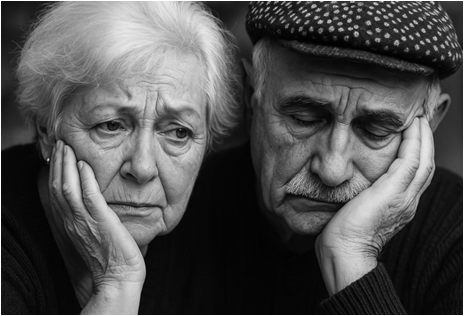
There is a loss happening in thousands of families across the UK that almost nobody talks about. Not in the news. Not in the support networks. Not in the legal system that is supposed to protect families. Grandparent alienation in UK is growing — and grandparents are being cut off from their grandchildren suddenly, deliberately, and with no clear recourse — while the world largely treats it as a private family matter that will sort itself out.
It does not sort itself out.
This post is for every grandparent sitting with that loss. And it is for every professional, social worker, family lawyer, or well-meaning friend who wants to understand what this actually is — not as a custody dispute, but as a form of family abuse that leaves some of the most profound and irreversible wounds of any alienation experience.
What is grandparent alienation?
Grandparent alienation in the UK is the deliberate severing of the relationship between a grandparent and their grandchildren — usually by an adult child, or by an adult child’s partner. It is rarely a single event. It is a process. Contact reduces, then becomes conditional, then becomes impossible. Calls go unanswered. Invitations are declined. The grandchildren begin to say things that don’t sound like them.
It is rooted in the same dynamics as all alienation: power and control. Someone in the family system — usually the adult child or their partner — has decided that the grandparent poses a threat to their narrative, their control, or their version of the family story. And so the grandparent is removed.
Sometimes this happens as a direct extension of parental alienation. A targeted parent is cut off from their children — and that parent’s family, including the grandparents, is swept out with them. In one action, grandchildren lose not just a parent but an entire side of their family: the grandparents, the aunts and uncles, the cousins, the whole branch of who they are.
Sometimes it happens independently — an adult child, often under the influence of a controlling partner, makes a unilateral decision to end contact. No explanation. No warning. The door simply closes.
Why grandparent alienation is different — and in some ways crueller
When we talk about the harm of parental alienation, we usually focus on targeted parents. That harm is devastating and well-documented. But grandparent alienation in the UK carries dimensions that are worth naming separately.
The window closes differently.
A targeted parent who loses contact with a young child has time on their side in at least one sense: the child will grow up. They will, eventually, be old enough to ask questions, to seek the other parent out, to form their own view. Reconnection is possible.
For grandparents, this calculus is brutal. By the time a grandchild reaches the age where they could independently seek out an estranged grandparent — where they might begin to question the story they were told — the grandparent may not be here. Or may be here but profoundly changed by age and illness. No longer able to take them out. No longer able to play on the floor with them, teach them things, pass on the ways and the wisdom that grandparents carry.
This is not a wound with a long recovery arc. This is a window, and it closes.
What grandparenting actually is — and what gets stolen.
The relationship between a grandparent and a grandchild is unlike any other in a child’s life. It carries something that parents, by definition, cannot offer: the long view. A grandparent has lived through things. Has made mistakes and come back from them. Has a kind of calm that only arrives after decades of living. They carry the family’s history — the stories, the names, the ways of doing things that stretch back generations.
When a grandchild is alienated from their grandparents, they do not just lose contact with two people. They lose the family tree made flesh. They lose the recipes, the sayings, the photographs that would have been shown and explained. They lose the particular safety of a grandparent’s home — a place with different rules, different rhythms, unconditional love with nothing to prove.
I know this from the inside. I was seven years old when my mother took me and I never saw my paternal grandparents again. I do not know what they tried to do, what they hoped for, or what they carried for the rest of their lives. I know what I lost — half of my family history, gone. The stories I was never told. The ways I was never taught. The people who might have helped me understand who I was.
The legal position for grandparents in the UK
Targeted parents, for all the failures of the family court system, have direct legal standing. They can apply for a Child Arrangements Order. They are recognised as a party to the child’s life.
For grandparents in England and Wales experiencing grandparent alienation in the UK, there is no automatic right to contact with their grandchildren. Before they can even apply for a Child Arrangements Order, they must apply to the court for leave — permission to make that application.
Once they have leave, the process is the same as for any private family law matter: slow, expensive, emotionally destructive, and uncertain. Legal aid is almost entirely unavailable for private family law. Every hearing, every letter, every application is self-funded — often by someone on a pension, in their sixties or seventies, with finite resources and finite energy.
Many grandparents reach the point of understanding what the legal process entails and simply cannot pursue it. Not because they don’t want their grandchildren. Because the system has been designed, whether intentionally or not, to make it too costly to reach.
The grief has no name
Disenfranchised grief is grief that society does not recognise. There is no funeral. No ritual. No language. People do not bring flowers or ask how you are. They assume it will resolve. They say ‘give it time’ — not understanding that time is the very thing a grandparent does not have in abundance.
The grandchildren are alive. That fact makes it invisible to the outside world. What could there be to grieve? They’re not gone.
But they are gone. From your daily life, from your kitchen table, from the ordinary afternoons that are what a relationship is actually made of. Your nervous system does not know the difference between a death and a disappearance. It responds the same way: with shock, with searching, with a kind of suspended grief that never gets to complete because there is no ending to point to.
Many grandparents carry this entirely alone. There are few support structures built for them. Many cannot afford counselling or coaching. They are largely invisible to the services that might otherwise help.
The betrayal
For most grandparents facing alienation, the person who has done this — or allowed it to happen — is their own child.
The one they raised. Sat up with at night. Drove to school, to hospital, to wherever they needed to be. Made mistakes with — because all parents make mistakes — but loved without reservation and without condition.
That child is now treating them as disposable. After a lifetime. As though nothing that was given, nothing that was shared, nothing that was sacrificed counts for anything.
There is a particular cruelty in being discarded by your own child. It reaches somewhere that other losses do not reach. It raises questions — about yourself, your worth, your whole life’s meaning — that no person deserves to sit with.
And it is worth naming clearly: making mistakes as a parent does not mean you deserve this. All parents make mistakes. All families have their difficulties, their ruptures, their moments that were handled badly. None of that justifies alienation. None of that justifies removing grandchildren from the people who love them.
What is happening to you is disproportionate. It is unfair. And it is not a reflection of your worth.
What grandparents can actually do
If you are experiencing grandparent alienation in the UK, these are your options:
Talk to a specialist family solicitor before taking any steps. The legal landscape for grandparents is specific and complex, and understanding it before committing to any course of action will save significant time, money, and distress.
Consider mediation. In some circumstances, family mediation can open a door that has been closed. It requires the other party to be willing to engage, which is not always the case where control dynamics are present. But where there is any openness, it can be worth exploring before pursuing a court process.
Find support — not just information. The legal and practical information matters. But what is happening to your nervous system while you carry this also matters. The chronic stress, the cortisol flooding, the hypervigilance, the sleep destruction — these are real physiological consequences of what you are going through, and they require attention.
Connect with others who understand. Isolation compounds this grief. Being with people who have lived it — who do not need it explained, who do not suggest you give it time — is not a luxury. It is part of how people survive this.
A note about the children
Grandchildren who are alienated from their grandparents do not always know what they are losing. They are told a story. They adapt to it. They survive inside it, the way children always do.
But they carry the loss nonetheless — often as a vague sense of something missing, an incomplete picture of who they are, a gap in their family history that nobody will explain. Some will grow up and begin to ask questions. Some will find their way back, if there is still someone there to find.
The goal of this work is not only to support grandparents through what is happening now. It is to keep them standing, keep them present, keep them reachable — so that if and when that grandchild turns around and looks, there is someone there.
I understand this from both sides
I’m Kevin Webb — somatic trauma-informed coach, educator, alienated parent, and alienated adult child.
I lost my entire paternal side of the family at seven years old. I know what it is to grow up without the grandparents who would have been there. I know the gaps that never quite close, the history that was never passed on.
I have worked with targeted parents and alienated families across the UK for years — support groups, presentations, direct coaching through the worst of what family breakdown produces. I know the legal landscape. I know what the family court system does and does not do. And I know, from the inside, what this does to a person’s body and sense of self.
If any of this has reached you — if you are sitting with grandparent alienation in the UK and carrying it without support — a conversation with someone who already understands what this is might be the right next step. By phone in the UK or Zoom internationally. No forms, no waiting list.
Kevin R Webb (MEd.L, BEd., BA Fd., QTS)
Somatic Trauma Informed Narcissistic Abuse Coach
Your situation – an alienated grandparent or extended family member →


