
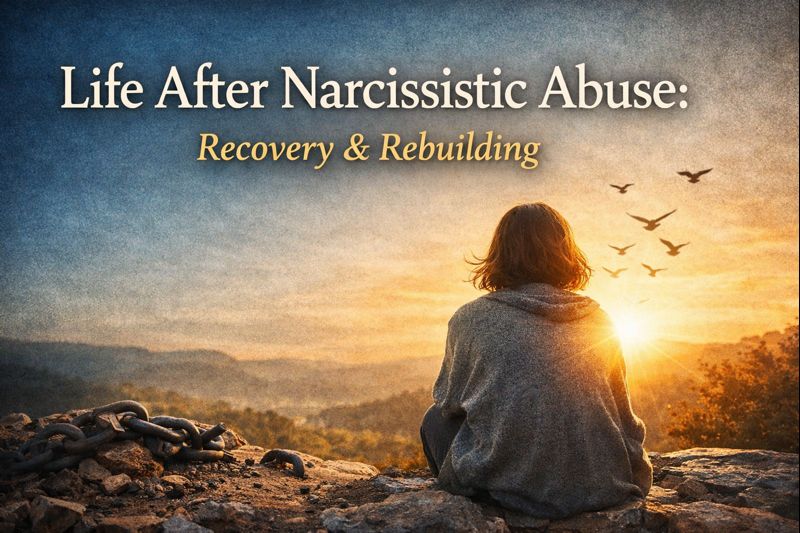
Life After Narcissistic Abuse: Recovery and Rebuilding
Life after narcissistic abuse is rarely spoken about honestly. Once a relationship, family dynamic, workplace, or system ends, many people expect relief — but instead experience confusion, exhaustion, emotional overload, and a loss of identity. Narcissistic abuse recovery is not about “getting over” what happened; it is about rebuilding a life after prolonged psychological harm, coercive control, and erosion of autonomy.
Life After Narcissistic Abuse Is Not Immediate Freedom
For many survivors, distance from the abusive person does not bring instant clarity or peace. Instead, it often marks the beginning of a deeper recovery phase — one involving reality-checking, reassessing the past, and understanding how life became so restricted.
This stage is not weakness. It is integration.
After narcissistic abuse, people commonly experience:
- internalised gaslighting (“Did this really happen?”),
- self-doubt and misplaced responsibility,
- emotional numbness or overwhelm,
- bitterness or anger as clarity emerges,
- withdrawal from people or stimulation,
- loss of pleasure or vitality,
- difficulty identifying emotions or needs.
These are not character flaws. They are adaptive responses to prolonged psychological manipulation and loss of agency.
Identity Erosion and the Work of Self-Reclamation
One of the most damaging impacts of narcissistic abuse is identity erosion. Over time, people often give up parts of themselves — preferences, boundaries, ambitions, bodily signals — in order to maintain safety, stability, or connection.
Recovery involves:
- reconnecting with the self,
- rediscovering what feels safe and right in the body,
- identifying coping mechanisms that once protected but no longer serve,
- grounding back into daily life and surroundings,
- learning to trust internal signals again.
This is not self-absorption. It is self-reclamation.
Bitterness, Moral Injury, and Why Recovery Takes Time
As understanding deepens, anger or bitterness often emerges — not because someone is becoming bitter, but because a moral boundary has been violated. Betrayal, deception, and abuse create moral injury, and anger is frequently a sign that self-respect is returning.
The risk is not feeling anger.
The risk is remaining there.
In healthy recovery, bitterness gradually transforms into boundaries, discernment, and self-respect rather than becoming a fixed identity. This process is often slow and non-linear, particularly when abuse occurred within families, long-term relationships, workplaces, or involved parental alienation.
Recovery commonly takes years, not months — and that timeline is normal.
Life After Narcissistic Abuse Is About Living Well, Not Erasing the Past
Recovery does not mean forgetting what happened. It means no longer organising one’s entire life around it.
With the right support, people can:
- regain nervous system stability,
- rebuild identity and agency,
- reconnect with pleasure and vitality,
- create lives shaped by values rather than harm,
- move toward human flourishing, not just survival.
Life after narcissistic abuse is not about returning to who you were before.
It is about becoming who you are now — grounded, self-directed, and intact.
Kevin R Webb (MEd.L, BEd., BA Found., QTS), Somatic Trauma Informed Narcissistic Abuse Coach
The video below explores what life after narcissistic abuse actually looks like — including recovery, identity erosion, integration, and rebuilding life beyond coercive control. Please remember to ‘like’, ‘share’, ‘comment’ and ‘subscribe‘ to help the channel reach other survivors.
If this resonates with you, please:
- Watch the full video for validation and insight
- Share your story in the comments — your voice may help someone else feel less alone
- Spread this video to others who might be struggling in silence
Support
If you are navigating life after narcissistic abuse and would like support that is trauma-informed, grounded, and focused on recovery and integration rather than re-telling the abuse, you don’t have to do this alone.
I offer somatic, trauma-informed coaching sessions (online, worldwide), and an initial chat to explore whether support would be helpful.
Initial chat / contact:
https://thepowerandcontrolwheel.co.uk/contact/
Book coaching sessions:
https://thepowerandcontrolwheel.co.uk/booking/
Recovery is possible — even when the experience itself becomes part of your life story.
You are not alone.
support@thepowerandcontrolwheel.co.uk
Get the trauma-informed help you deserve.
Book a session, access resources, and join the movement to break the cycle.
👉 Book a free 30-minute discovery call to explore if trauma-informed coaching is the right next step for you.
👉 Book a 1-hour Somatic Coaching Support Session today — affordable, faith-friendly, and trauma-informed.
Consider telling your story with an interview. Anonymity is available.
Let’s reconnect you to your voice, your power, and your path forward.
If this resonated with you, please join me on Zoom to share your story. Your voice matters. Let’s raise awareness about the silent epidemic of parental alienation and narcissistic abuse.
Other social media pages for The Power And Control Wheel:
www.facebook.com/thepowerandcontrolwheel
www.instagram.com/thepowerandcontrolwheel
www.x.com/controlwheel
LinkedIn – www.linkedin.com/in/kevinwebbmed/
info@thepowerandcontrolwheel.co.uk
A note on recovery:
This work is not about “healing” in the sense of erasing what happened. Narcissistic and coercive abuse often leave lasting psychological and relational impacts. Recovery is about integration, rebuilding, and learning to live well with an experience that becomes part of one’s life story — not pretending it never occurred or striving to be unchanged by it.

Leave a Reply